Joseph Callaly
Contact
joseph.callaly[at]monash.edu
linkedin
bluesky
substack
instagram
My research examines listening infrastructures: the technical and institutional arrangements that decide how hearing is organised and whose hearing counts as typical.
My artistic practice works with those arrangements as material, building custom instruments and software for sound installations, spatial audio and performance.
RESEARCH
Publications
Callaly, J. (2025). ‘On Transversal Creativities: Figures of a Sonic and Machinic Apparatus’. PhD thesis. Monash University.
Callaly, J. (2026). ‘Hearing Différances: The Tinnital Self through the Lens of Barad’. in Diffractions: Karen Barad and Music Studies, Edinburgh Univeristy Press, Resonances: Critical Engagements with Music and Philosophy. (In press).
Callaly, J. (2026). ‘An Economics of Audibility: Measuring Urban Ear-Time and Sonic Citizenship over 24 Hours’. Seismograf Peer.
Callaly, J. (2026). ‘Replaying an Imagined Past: Adoptive Fictioning and the Counter-Archives of Aloïse and Walshe’. Performance Research. (In press).
Callaly, J. (2026). ‘Platform Audibility and Fairness in the Testing Conditions of Music Recommendation’. Conference Proceedings of the 24th STS Conference Graz 2026. Critical Issues in Science, Technology and Society Studies. Verlag der Technischen Universität Graz. (In press).
Callaly, J. (2026). ‘Machine Listening and the Art of Ecological Attention’. INSAM Journal of Contemporary Music, Art and Technology. (In review).
Callaly, J. (2026). ‘Dead labour, virtual ghosts: Real-money trading and financialised agencies in Old School RuneScape’s Revenant Caves’. Convergence: The International Journal of Research into New Media Technologies. (In review).
Software
Callaly, J. (2026). ‘Ricochet: a real-time choreographic engine for spatial music’. Monash University. DOI: 10.26180/33390514.v1
Talks
Callaly, J. (2026). ‘Thinking Machine Listening and the Acoustic Milieu through Simondon’, at 50th Annual Meeting of the Society for Social Studies of Science (4S), Toronto, Canada. (Forthcoming).
Callaly, J. (2026). ‘Noise-Work: Performing Humanness under Automated Suspicion’, at the Biennial Screen Studies Association of Australia and Aotearoa New Zealand (SSAAANZ) Conference 2026, Melbourne University, Melbourne, Australia. (Forthcoming).
Callaly, J. (2026). ‘Formatting Audibility for Machine Listening Systems’, at Eleventh International Conference on Communication & Media Studies, Nanyang Technological University, Singapore.
Callaly, J. (2026). ‘Gestural Interactive Composition using OSC’, Composition & Music Technology Creative Practices Series, Monash University, Melbourne, Australia.
Callaly, J. (2026). ‘Platform Audibility and Fairness in Music Recommendation’, at 24th Annual Critical Issues in Science, Technology and Society Studies (STS) Conference Graz, Graz University of Technology, Graz, Austria.
Callaly, J. (2026). ‘Music Recommender Systems as a Cultural Mode of Listening’, at 19th International Conference of Students of Systematic Musicology, Durham University, Durham, UK.
Callaly, J. (2026). ‘Phantom Listening: Tinnitus and Sonic World-Making’, SoMP Research Seminar Series, Monash University, Melbourne, Australia.
Callaly, J. (2025). ‘Baradian Perspectives onTinnitus and Diffractive Research Methodology’, at Diffractions: An International Symposium on Barad and Music Studies, Griffith University, Brisbane, Australia.
Callaly, J. (2025). ‘Improvisation as Concept-Creation in Practice Research’, at Australian Jazz and Improvisation Research Network Conference 8, Waipapa Taumata Rau/University of Auckland, Auckland, New Zealand.
Callaly, J (2025). ‘The Studio as Instrument’, Composition & Music Technology Creative Practices Series, Monash University, Melbourne, Australia.
Publications
Callaly, J. (2025). ‘On Transversal Creativities: Figures of a Sonic and Machinic Apparatus’. PhD thesis. Monash University.
Callaly, J. (2026). ‘Hearing Différances: The Tinnital Self through the Lens of Barad’. in Diffractions: Karen Barad and Music Studies, Edinburgh Univeristy Press, Resonances: Critical Engagements with Music and Philosophy. (In press).
Callaly, J. (2026). ‘An Economics of Audibility: Measuring Urban Ear-Time and Sonic Citizenship over 24 Hours’. Seismograf Peer.
Callaly, J. (2026). ‘Replaying an Imagined Past: Adoptive Fictioning and the Counter-Archives of Aloïse and Walshe’. Performance Research. (In press).
Callaly, J. (2026). ‘Platform Audibility and Fairness in the Testing Conditions of Music Recommendation’. Conference Proceedings of the 24th STS Conference Graz 2026. Critical Issues in Science, Technology and Society Studies. Verlag der Technischen Universität Graz. (In press).
Callaly, J. (2026). ‘Machine Listening and the Art of Ecological Attention’. INSAM Journal of Contemporary Music, Art and Technology. (In review).
Callaly, J. (2026). ‘Dead labour, virtual ghosts: Real-money trading and financialised agencies in Old School RuneScape’s Revenant Caves’. Convergence: The International Journal of Research into New Media Technologies. (In review).
Software
Callaly, J. (2026). ‘Ricochet: a real-time choreographic engine for spatial music’. Monash University. DOI: 10.26180/33390514.v1
Talks
Callaly, J. (2026). ‘Thinking Machine Listening and the Acoustic Milieu through Simondon’, at 50th Annual Meeting of the Society for Social Studies of Science (4S), Toronto, Canada. (Forthcoming).
Callaly, J. (2026). ‘Noise-Work: Performing Humanness under Automated Suspicion’, at the Biennial Screen Studies Association of Australia and Aotearoa New Zealand (SSAAANZ) Conference 2026, Melbourne University, Melbourne, Australia. (Forthcoming).
Callaly, J. (2026). ‘Formatting Audibility for Machine Listening Systems’, at Eleventh International Conference on Communication & Media Studies, Nanyang Technological University, Singapore.
Callaly, J. (2026). ‘Gestural Interactive Composition using OSC’, Composition & Music Technology Creative Practices Series, Monash University, Melbourne, Australia.
Callaly, J. (2026). ‘Platform Audibility and Fairness in Music Recommendation’, at 24th Annual Critical Issues in Science, Technology and Society Studies (STS) Conference Graz, Graz University of Technology, Graz, Austria.
Callaly, J. (2026). ‘Music Recommender Systems as a Cultural Mode of Listening’, at 19th International Conference of Students of Systematic Musicology, Durham University, Durham, UK.
Callaly, J. (2026). ‘Phantom Listening: Tinnitus and Sonic World-Making’, SoMP Research Seminar Series, Monash University, Melbourne, Australia.
Callaly, J. (2025). ‘Baradian Perspectives onTinnitus and Diffractive Research Methodology’, at Diffractions: An International Symposium on Barad and Music Studies, Griffith University, Brisbane, Australia.
Callaly, J. (2025). ‘Improvisation as Concept-Creation in Practice Research’, at Australian Jazz and Improvisation Research Network Conference 8, Waipapa Taumata Rau/University of Auckland, Auckland, New Zealand.
Callaly, J (2025). ‘The Studio as Instrument’, Composition & Music Technology Creative Practices Series, Monash University, Melbourne, Australia.
WORKS
Contre-forme
Contre-forme is a real-time sound installation that plays the inversion of a noise suppression algorithm. A microphone listens to the exhibition space, a DeepFilterNet model divides the signal into speech and everything else, and the loudspeakers play back only what the model was designed to destroy. A portrait screen shows the same computation as a scrolling spectrogram in which only the rejected sound is drawn, so that voices appear as voids with the internal structure of speech. The work is concerned with how audibility is decided in advance by listening infrastructures, and with what those infrastructures throw away.
Contre-forme is scheduled for exhibition at Thinking through Sound: Making a Noisy Encyclopedia, Shenzhen (2026), a conference of the editors and contributors to The Bloomsbury Encyclopedia of Sound Studies.
Contre-forme is scheduled for exhibition at Thinking through Sound: Making a Noisy Encyclopedia, Shenzhen (2026), a conference of the editors and contributors to The Bloomsbury Encyclopedia of Sound Studies.
Exposures
Exposures is a composition using computer vision within the twenty-channel DodekaOTTO array. An OAK-D camera tracks the orientation of the performer’s head, which determines which tones are generated. The dome is tuned as a just-intonation lattice: each loudspeaker corresponds to a single fixed pitch, neighbouring speakers are tuned a simple ratio apart, and each pentagonal face forms a chord. Where the performer lingers, the tones begin to spatially migrate, then disintegrate. Exposures is concerned with attention as a spatial and durational act.
Made in collaboration with Finnian Idris and developed at Monash University (2026).
Made in collaboration with Finnian Idris and developed at Monash University (2026).
Patterns of Self-Organisation (in Swarms)
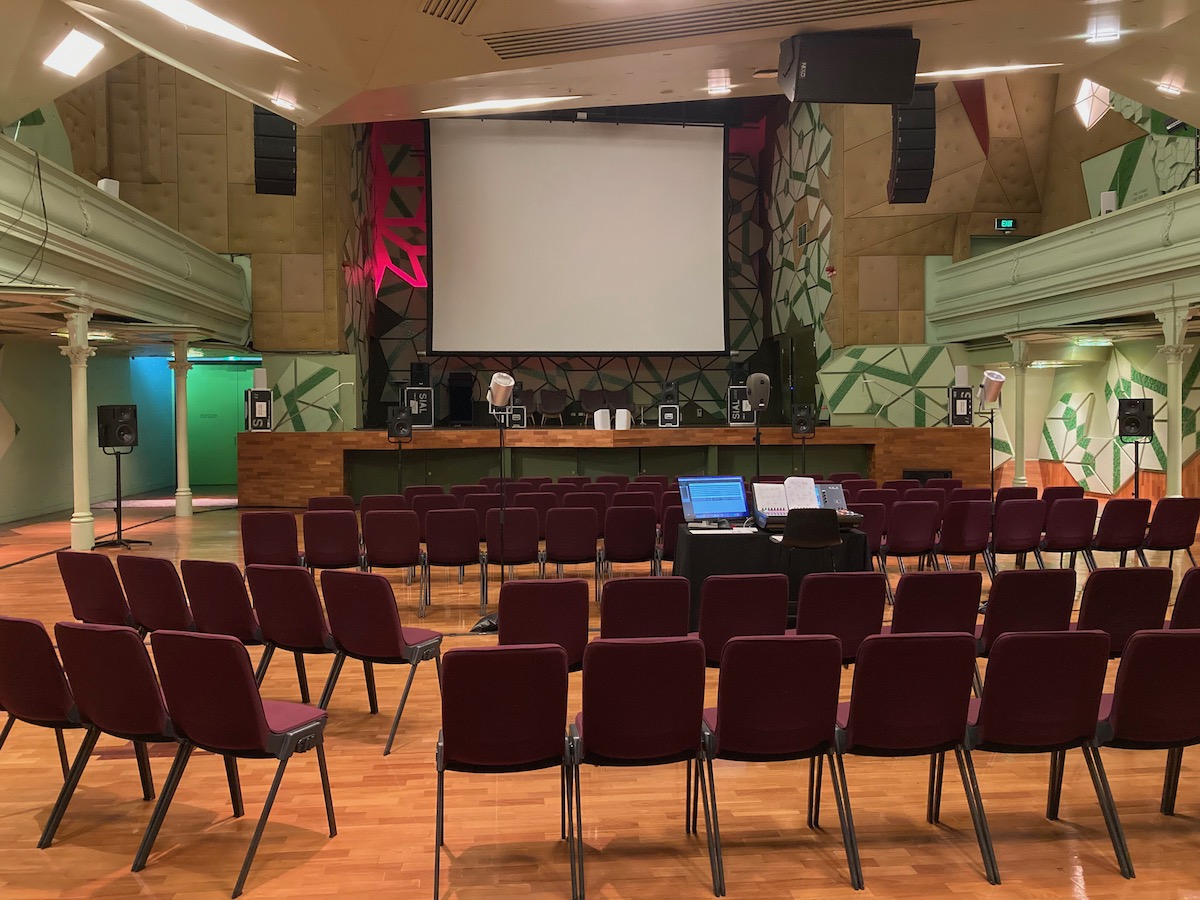
Patterns of Self-Organisation (in Swarms) is a multichannel sound work concerned with how small sonic fragments gather, disperse, and reorganise across space. Originally composed for 24-channel system for the Design and Sonic Practice Research Commission, the work has since taken different forms across concert and architectural settings. In its expanded installation form, sound is distributed through foyers, stairwells, and transitional spaces, so that the work is encountered through movement rather than from a fixed listening point. The work treats spatial audio as a condition for emergent organisation, where the building becomes part of the composition’s behaviour.
The Swarms project has been presented at RMIT's Black Box Gallery (2021), Miscellania for ONO (2022), Storey Hall for the Canadian Electroacoustic Community Jeu de Temps (2022), and Mycellium Studios for the Melbourne Immersive Sound Theatre (2026). In 2025, the Swarms project was performed at the Melbourne Recital Centre, for SIAL's Immersive Sonic Journeys.
DOI: 10.26180/33390787
The Swarms project has been presented at RMIT's Black Box Gallery (2021), Miscellania for ONO (2022), Storey Hall for the Canadian Electroacoustic Community Jeu de Temps (2022), and Mycellium Studios for the Melbourne Immersive Sound Theatre (2026). In 2025, the Swarms project was performed at the Melbourne Recital Centre, for SIAL's Immersive Sonic Journeys.
DOI: 10.26180/33390787
Oversetter
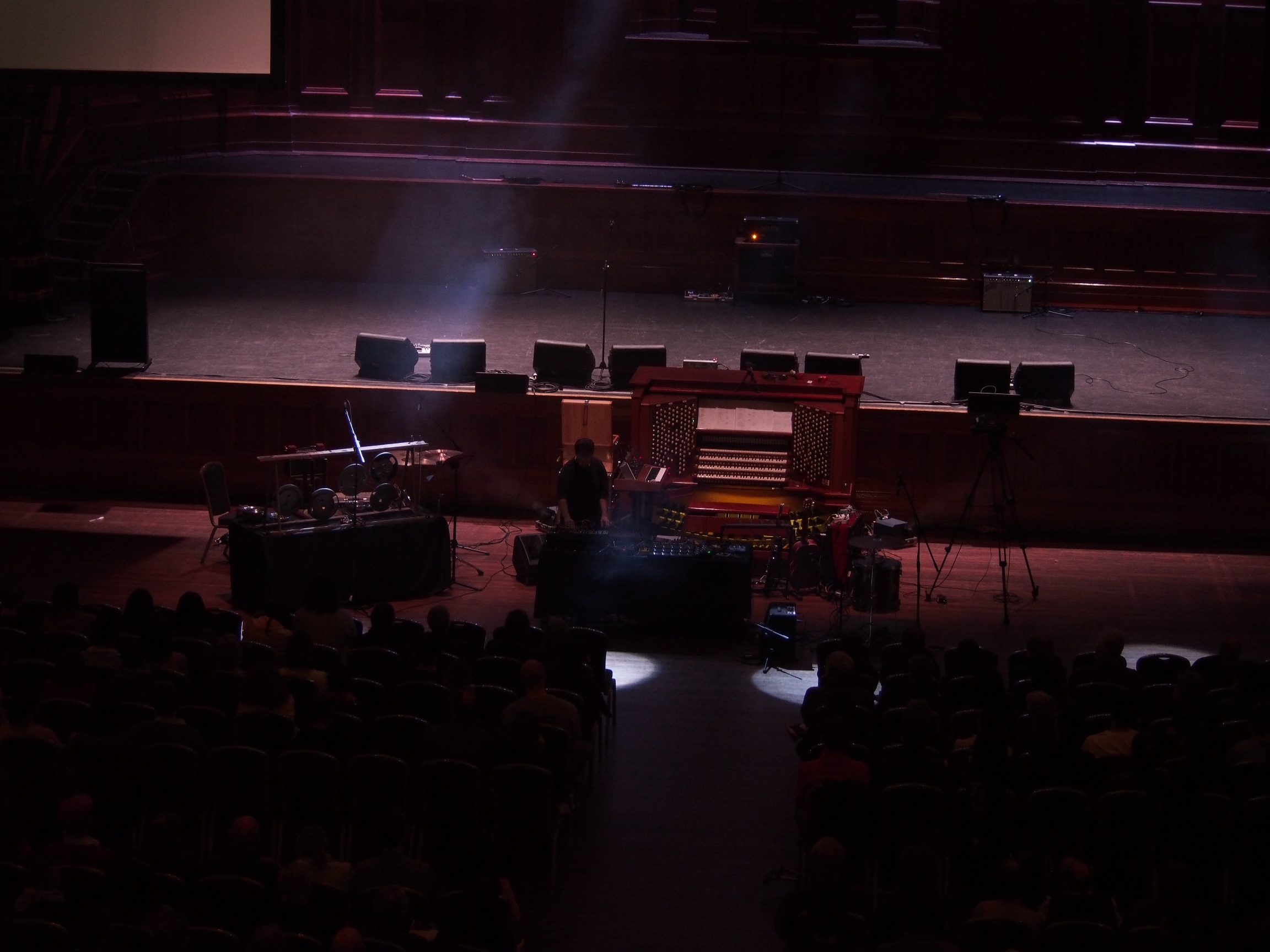
Oversetter is a performance for computer-controlled grand organ and electronics performed at Melbourne Town Hall (2018). The work begins from a problem of translation: how a digital signal might be carried across the mechanical, architectural, and acoustic body of the organ. Using spectral analysis to drive the instrument, the organ becomes a system of conversion rather than a stable instrument. Its historical machinery receives a contemporary signal and returns it through air, delay, and acoustic space. Oversetter is concerned with what happens when sound is transferred between incompatible bodies: the digital, the mechanical, the architectural, and the listening body gathered inside the hall.
DOI: 10.26180/33393997
DOI: 10.26180/33393997
SFFFB
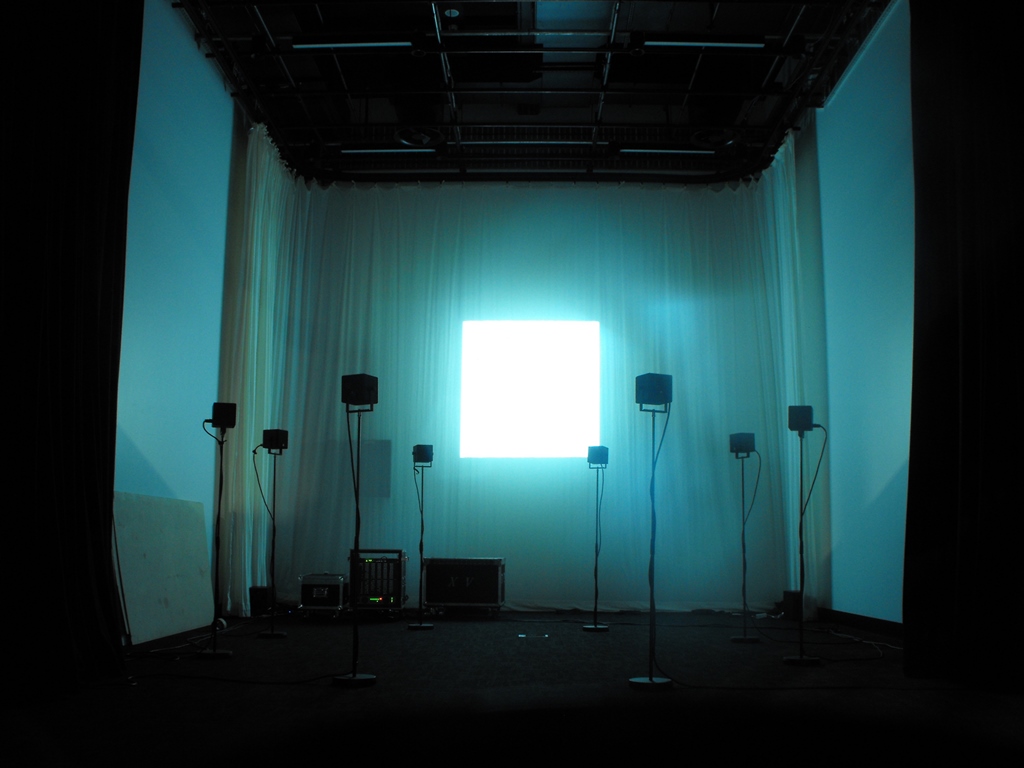
SFFFB (Spatial Fast Fixed Frequency Filter-Bank) is a multichannel sound installation developed for RMIT’s Black Box Gallery (2018). The work distributes the audio spectrum across an eight-channel spatial array, so that frequency becomes a way of organising position and movement. Rather than presenting sound as a unified object, the installation separates it into bands and directs them to different parts of the room. Listening is shaped by this technical partitioning. The work treats the filter bank as an infrastructural device: a system that divides, routes, and spatialises sound, making audible the conditions through which frequency becomes location.
Tone Field
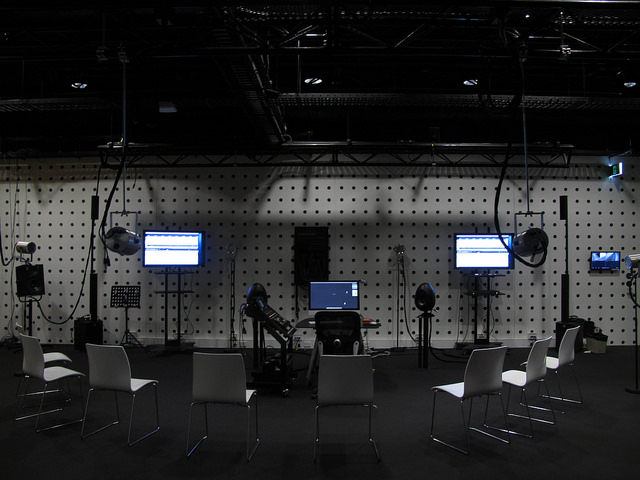
Tone Field is an ambisonic performance in which a performer navigates the position of a virtual listener through a field of stationary tones, originally presented at RMIT’s Spatial Information Architecture Laboratory (SIAL) (2017). The work models a large sonic space in which audibility depends on distance. Nearby tones become clear and present, while others recede. The performance is produced through the path taken across this field, thereby treating listening as a spatial traversal rather than a fixed perspective. Hearing is organised by position, distance, and the changing relation between a listener and the field they move through.
Empat Blok

Interactive Multimedia Installation at E-Gallery, Kuala Lumpur. Created in collaboration with Mike Hoo, Trent Borchard and Theodore Hassan, as part of a collaboration between RMIT and Multimedia University Malaysia (2019). The piece explores the perception of wealth inequality through projection mapped visuals and audio. Using infrared cameras, the viewers position in the room is detected and used to control the sound and vision, with different depictions presented to them as they move through the space. The sound was created by real-time mapping the coordinates of the viewer to parameters of a live cycling audio session, with the moods and timbres shifting in correspondence with the viewer's movements.
Deloop
Digital musical game funded by City of Melbourne (2020). Deloop is a musical toy designed to introduce the user to two musical concepts which fall outside the domain of traditional Western-focused music education. These two concepts are 1) non-traditional tuning systems, and 2) cyclical rhythmic structures. In this iteration, the user can switch between five non-equal temperament tuning systems. The piece was designed as part of a exegetical body of research into an interpretation of post-digital creativity within music education.
Pan-Alcidae
Ambisonic performance at the Spatial Informational Architecture Laboratory, RMIT, Melbourne (2018). Developed in Max/MSP - white noise is splintered into 50 constituent frequency bands - the locations of which are determined by the simulation of a flock of 50 birds. Each band moves dynamically around the virtual listener, being represented locationally by a single bird of the flock.